Symfony Laravel Package
apirelio/symfony
Apirelio Symfony SDK links API errors, latency, and releases to affected customers without capturing request or response payloads. It records normalized endpoint metrics and customer context with fail-safe delivery, excluding credentials, cookies, query strings, IPs, and personal data. Supports PHP...
Apirelio Symfony SDK


See the customer behind every API request
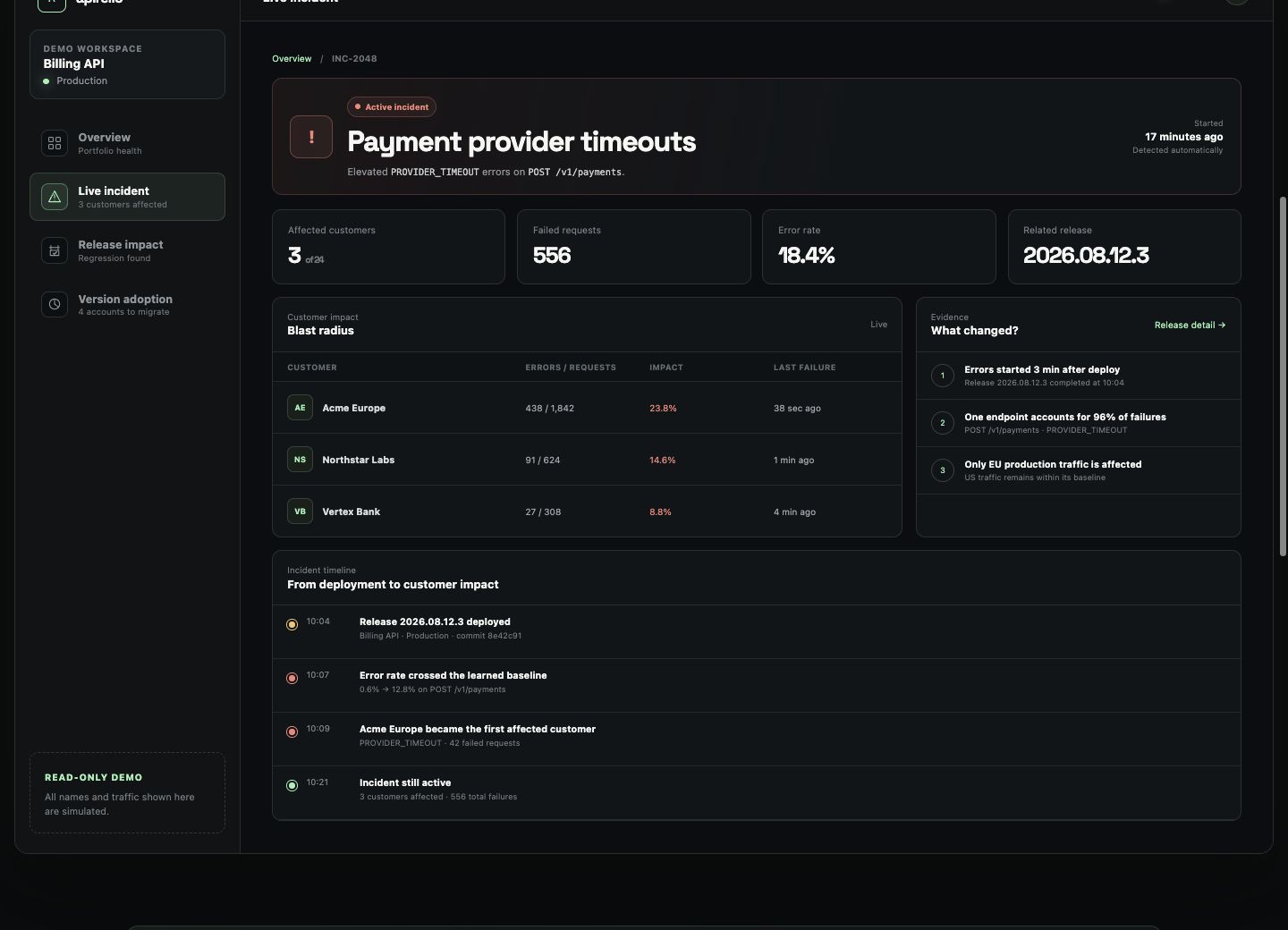
Follow a release regression from the failing endpoint to the exact customer accounts it affects in the public, read-only workspace.
Try it in 30 seconds
composer require apirelio/symfony
export APIRELIO_API_KEY=apr_live_your_project_key
Copy the minimal setup below or run the quickstart example. Delivery is fail-safe and no request or response payloads are captured.
Documentation · Packagist · Apirelio
Connect Symfony API errors, latency and releases to the affected customers without capturing request or response payloads.
Fail-safe customer integration analytics for Symfony APIs. The bundle records
normalized endpoint metrics and customer context without capturing request or
response bodies, credentials, cookies, query strings, IP addresses, or personal
data. The shared event contract, privacy rules and delivery primitives come
from apirelio/php-core, installed automatically by Composer.
Requirements
- PHP 8.2, 8.3 or 8.4
- Symfony 6.4, 7.4 or 8.x
Symfony 8 itself requires PHP 8.4. Symfony 6.4 and 7.4 can be used on PHP 8.2.
Installation
composer require apirelio/symfony:^0.2
Register the bundle:
// config/bundles.php
return [
    // ...
    Apirelio\Symfony\ApirelioBundle::class => ['all' => true],
];
Configure the project key shown once in the Apirelio dashboard:
APIRELIO_ENABLED=true
APIRELIO_ENDPOINT=https://apirelio.com
APIRELIO_API_KEY=apr_live_xxxxxxxxx
APIRELIO_SERVICE=billing-api
APIRELIO_ENVIRONMENT=production
APIRELIO_RELEASE=2026.07.29.1
# config/packages/apirelio.yaml
apirelio:
    enabled: '%env(bool:APIRELIO_ENABLED)%'
    endpoint: '%env(APIRELIO_ENDPOINT)%'
    api_key: '%env(APIRELIO_API_KEY)%'
    service: '%env(APIRELIO_SERVICE)%'
    environment: '%env(APIRELIO_ENVIRONMENT)%'
    release: '%env(APIRELIO_RELEASE)%'
    transport: messenger
    paths:
        - /api/*
The subscriber is registered automatically and records matching main requests.
Route templates are used instead of concrete URLs, so /api/invoices/123
becomes /api/invoices/{invoice} and query strings are never sent.
Messenger transport
The default messenger transport moves network delivery outside the customer
request. Route the SDK message to an asynchronous transport:
# config/packages/messenger.yaml
framework:
    messenger:
        routing:
            'Apirelio\Symfony\Message\BufferApirelioEvents': async
Run your normal Messenger worker:
php bin/console messenger:consume async
Failed ingestion requests throw inside the worker so Symfony Messenger can apply its configured retry and failure transport policies.
Customer and application identity
Create application-specific resolvers:
<?php

namespace App\Apirelio;

use Symfony\Component\HttpFoundation\Request;
use Apirelio\Symfony\Contracts\CustomerResolver;
use Apirelio\Symfony\Data\ApirelioCustomer;

final class ApiCustomerResolver implements CustomerResolver
{
    public function resolve(Request $request): ?ApirelioCustomer
    {
        $client = $request->attributes->get('api_client');

        return $client === null
            ? null
            : new ApirelioCustomer(
                id: (string) $client->companyId,
                name: $client->companyName,
                plan: $client->plan,
            );
    }
}
<?php

namespace App\Apirelio;

use Symfony\Component\HttpFoundation\Request;
use Apirelio\Symfony\Contracts\ApplicationResolver;
use Apirelio\Symfony\Data\ApirelioApplication;

final class ApiApplicationResolver implements ApplicationResolver
{
    public function resolve(Request $request): ?ApirelioApplication
    {
        $client = $request->attributes->get('api_client');

        return $client === null
            ? null
            : new ApirelioApplication(
                id: (string) $client->id,
                name: $client->name,
            );
    }
}
Bind them to the SDK contracts:
# config/services.yaml
services:
    Apirelio\Symfony\Contracts\CustomerResolver:
        alias: App\Apirelio\ApiCustomerResolver

    Apirelio\Symfony\Contracts\ApplicationResolver:
        alias: App\Apirelio\ApiApplicationResolver
Error codes and metadata
JSON error codes are read from error.code by default. Override a code or add
allow-listed metadata during the current request:
use Apirelio\Symfony\ApirelioManager;

final class SendInvoiceController
{
    public function __invoke(ApirelioManager $apirelio): Response
    {
        $apirelio
            ->setErrorCode('INVALID_CURRENCY')
            ->addMetadata([
                'integration_type' => 'accounting',
                'region' => 'eu-central',
            ]);

        // ...
    }
}
Declare allowed custom keys in the bundle configuration:
apirelio:
    metadata_keys: [integration_type, region]
Unlisted keys and non-scalar values are discarded.
Transports and buffering
messenger(default): dispatch locally and deliver from an async worker.sync: deliver immediately; intended for local diagnostics.file_buffer: append to a locked local NDJSON buffer and flush by batch size or interval.
For file_buffer, schedule a forced flush so low-traffic applications do not
leave a partial batch behind:
php bin/console apirelio:flush
Useful options:
apirelio:
    transport: messenger
    messenger_bus: messenger.default_bus
    timeout_seconds: 2
    connect_timeout_seconds: 0.5
    batch_size: 500
    flush_interval_seconds: 10
    buffer_path: '%kernel.cache_dir%/apirelio/events.ndjson'
    error_code_json_path: error.code
    capture_headers: [x-api-version, x-sdk-version, user-agent]
Resolver, transport, and logger failures are caught at the request boundary. Analytics may lose an event, but it never changes the customer API response or masks its exception.
How can I help you explore Laravel packages today?